
Monday, 18 June 2018
How do you like your coins?
Silly question, I suppose. Most people see a coin in an auction catalogue or list. It is well illustrated and described with the reference numbers from the standard texts. In 9 out of 10 cases no surprises, you get exactly what it says on the tin. It is rare for coins to be wrongly identified or catalogued.
But what is the fun in that? I like a challenge. the pleasure for me is going to a dealer with no idea of what is likely to be on offer, some weeks nothing at all and other times plenty on offer. My last purchases were a Gibraltar token of 1818, a 1 skilling overstruck on a coin of the previous century and a double liard from 1709 in the Spanish Netherlands. the double liard is quite rare as is the Gibraltar token.
These were all fairly easy to identify. some weeks I pick out the coins I have never seen before and require a bit of research. that for me is the pleasure of collecting; finding researching and learning. perhaps I am rarity.

Saturday, 2 June 2018
The theme for the next meeting is women on coins.
Here are some random coins. What would you have chosen?

Modern 50 p commemorating votes for women. Coin of Hadrian showing a sad Britannia
Hadrian's wife, Sabrina and a modern example of Britannia looking a bit more cheerful.

A jetton commemorating Queen Elizabeth's help to the Dutch protestants. a marriage medalet of Charles I and Henrietta.
A jetton of Louis XIV and his wife and an unknown couple.
Saturday, 12 May 2018

The theme this month was politics and change.
Here are some
items that show this well. A Charles I Royalist badge and top right a Sierra
Leonne anti slavery penny token. in the centre is a modern coin from
Slovenia. A partisan with the symbol
of the communist regime on a modern coin was controversial. Some considered the
partisan commander as a war criminal, while others called it a provocation
precisely because it happened when Slovenia was preparing to celebrate its
twenty years of independence.
At the bottom two
less controversial coins, a 50 p commemorating the Battle of Hastings and a
£2.00 commemorating the Magna Carta.
Monday, 7 May 2018
Where are all the books?
I can tell that alot of the coins I buy that have belonged
to keen collectors. They come with well researched coin tickets and sometimes
give provenance. When I have purchased a collection I can see they were put
together over years, sometimes generations. Sometimes it is possible to tell where
the collector lived or worked when he or she assembled them.
But where are the books? They must have had books to
identify the coins. At the time they were acquired there was no internet. Yes
may have been identified elsewhere or by other collectors.
Certain dealers reluctant to take books. They are bulky,
expensive to store and move around. (I mean the books not the dealers-
although…) Perhaps they think there is not much profit in them.
Will internet do away with books? There is a lot on internet
I rely on Wildwinds and there are a number of excellent specialist sites,
particularly on medieval coins. Many older books have been transcribed or
scanned. Aut0matic tran£cripLion is no! alwaus e%act.
Some of the museum websites are extensive but I find them
difficult to find way around rather like the museums themselves. If you know
what you are looking for easy but if not then no. Internet has made some easier.
You can just search using the words of an inscription or very general phrase such
as “Roman silver coin with Zeus sitting” and get lucky.
However the collector needs books. It is much easier and
quicker to use a book and older books are a pleasure in themselves.
Thursday, 3 May 2018
Saturday, 21 April 2018


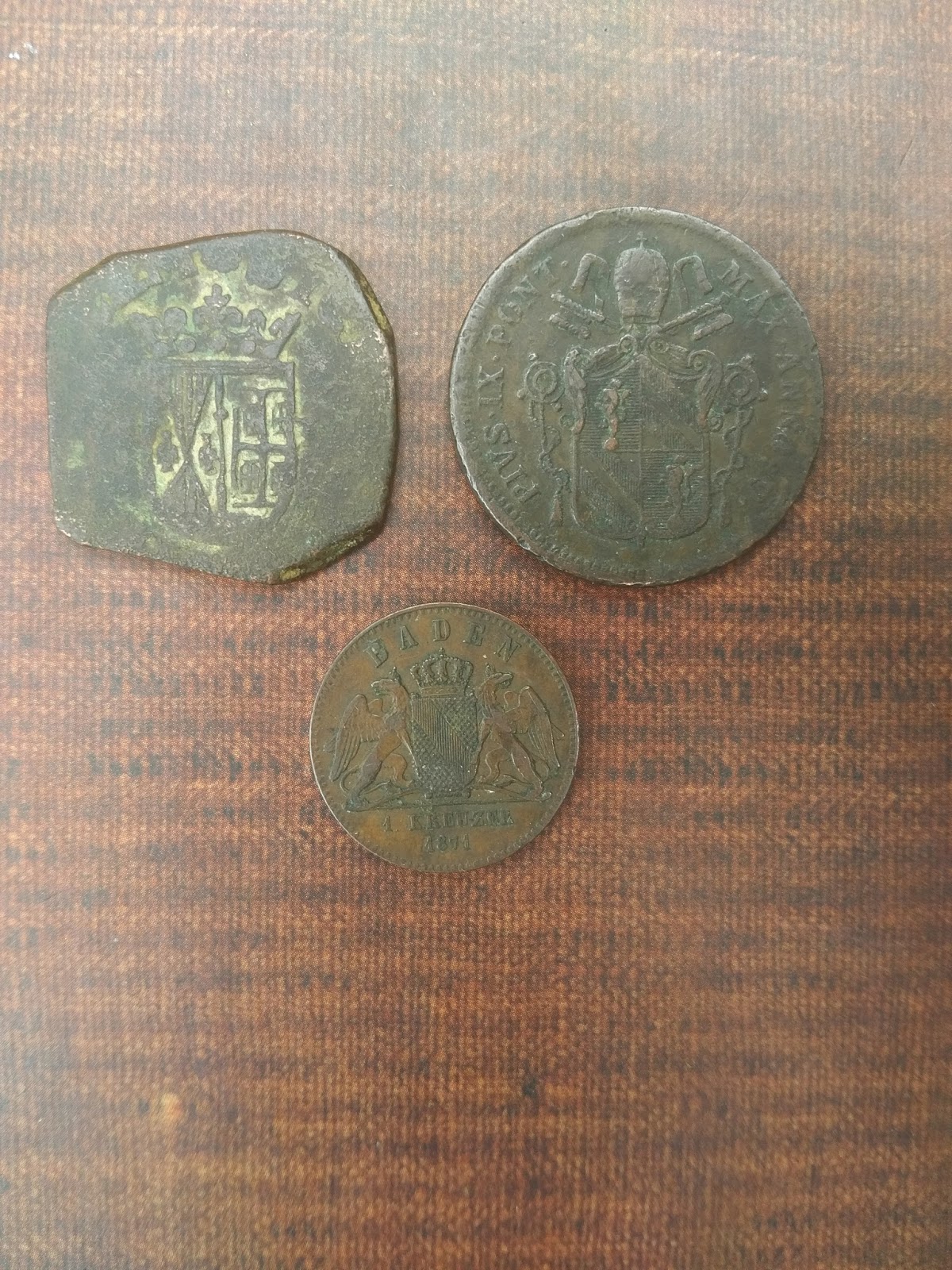
The company you keep.
These are three copper coins I bought last Saturday for the princely sum of £9.00. "I was robbed" do you say?"
The first time you look the bottom coin seems to be a fairly common copper 1 Kreuzer and on a second glance so it is - but it has the inscription FRIEDENS FEIER which refers to the Prussian victory over the French in the Franco-Prussian War. so that makes interesting.
the top right is a standard coin from the Vatican. I always find this series interesting. the left one is a bit of a mystery. It was sold with a quite nice large copper coin from Sicily and it was a fair bet that it is Italian as well. It is not in good condition but you can just about see the arms of the kingdom of Jerusalem on left and kingdom of Sicily. the obverse has the armoured bust of a king.
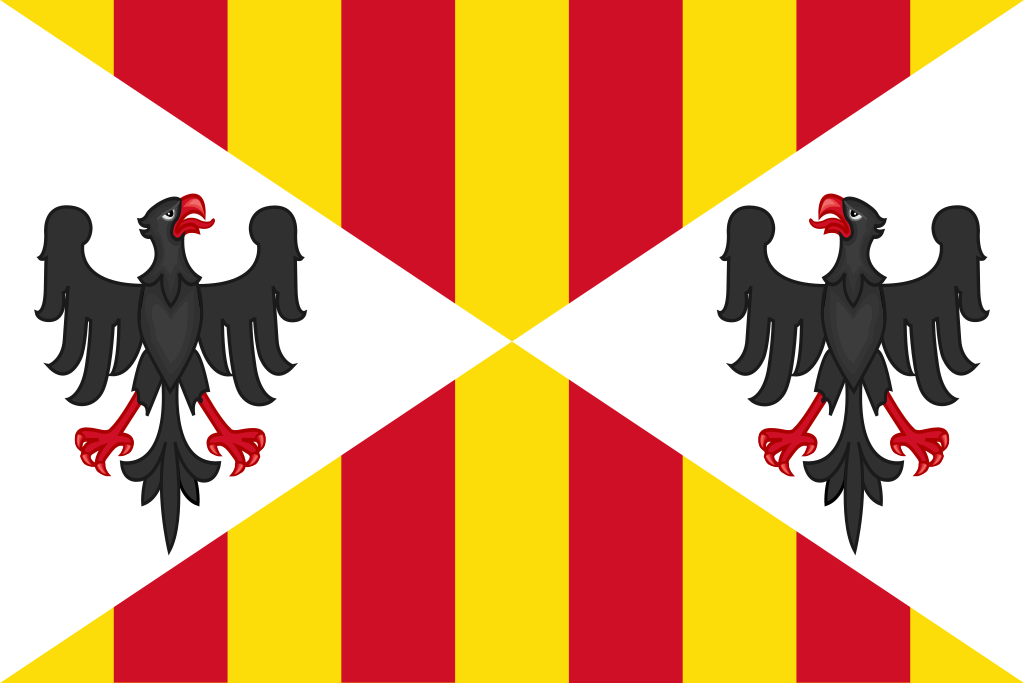
I have another copper of Sicily which was struck by one of the Spanish Philips. both have very irregular flans. the other one is virtually hexagonal. I dont know why; perhaps they were struck in a hurry or were not bothered if the coins were circular or not.
Not bad for £9.00
Sunday, 1 April 2018

I always thought this taler was
a religious one but when I researched it I found it is a “Truth taler” and was
issued for political reasons. Happy Easter everyone.
In the late 16th Century, Heinrich Julius
wanted to implement legal reform. At the time, the legal system was based on
the Saxon system of using local elders to adjudicate. This is similar to the
Anglo-Saxon witanagemot from almost 1000 years earlier and that which is still
in use unofficially or officially in the Middle East, Central Asia and South
Asia and probably elsewhere.
Heinrich
Julius wanted to replace the Saxon system with the Roman system where the laws
and procedures are codified. (This is actually the Hammurabi system.) But this
meant that the local elders will lose much of their influence, and that caused
political discord between the two sides.
source
Subscribe to:
Posts (Atom)